Series of Article 2 of 3 – Netherlands 1974
Football has always been fascinated by the teams that win. Their captains lift trophies, their managers become national heroes and their names are preserved in record books. Yet some sides leave a mark that cannot be measured by medals alone.
The Netherlands team of 1974 is perhaps the finest example.
They did not win the World Cup. They lost the final to the host nation, West Germany, despite taking the lead before their opponents had even touched the ball. There would be no triumphant captain holding the new FIFA World Cup Trophy above his head, no victory parade celebrating a first Dutch title and no place beside Brazil, Italy or West Germany on the official roll of honour.
Instead, they received something far less tangible but, in its own way, almost as valuable.
They became immortal.
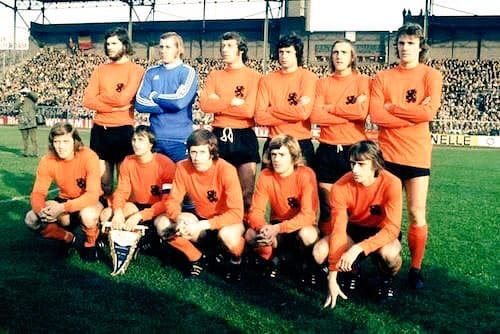
For supporters who watched them in West Germany, the memories remain vivid: the orange shirts, the constant movement and the unmistakable figure of Johan Cruyff appearing wherever the game seemed most important. Players exchanged positions so naturally that traditional formations appeared to dissolve. Defenders attacked, forwards retreated into midfield and opponents struggled to understand who they were supposed to mark.
It became known as Total Football, although the term can sometimes make the idea sound more complicated than it was. At its heart, the philosophy depended upon intelligence, technical ability and collective responsibility. When one player moved out of position, another filled the space. The team expanded when it had the ball and compressed the pitch when possession was lost.
Every player was expected to understand the entire game rather than simply his own individual role.
That may seem familiar to modern audiences. Elite sides now press together, build attacks through goalkeepers and ask full-backs to operate in midfield. Positional rotation has become part of the language of contemporary coaching.
In 1974, it felt revolutionary.
The roots of the Dutch approach had been established at Ajax under Rinus Michels, the stern and innovative coach known as “The General”. Ajax won three consecutive European Cups between 1971 and 1973, although Michels had moved to Barcelona after the first of those triumphs. His ideas remained central to the club and were carried onto the international stage by a group of players who understood them instinctively.
At the centre of everything stood Johan Cruyff.
Cruyff was not merely the Netherlands’ best player. He was their interpreter, conductor and most demanding voice. Tall, lean and instantly recognisable, he appeared to see the game a fraction earlier than everyone around him. He could receive the ball under pressure, accelerate into space or slow the contest down until a passing lane appeared.
His influence went beyond individual skill. Cruyff directed teammates, questioned decisions and understood Michels’ ideas almost as deeply as the coach himself. The footballer and the system seemed made for one another.
Around him was a side of considerable talent. Johan Neeskens supplied energy, aggression and goals from midfield. Ruud Krol was an elegant and adventurous defender. Arie Haan could move from defence into midfield, while Wim Jansen and Wim van Hanegem brought intelligence and balance. Johnny Rep and Rob Rensenbrink provided movement and danger in the forward positions.
This was not simply Cruyff and ten supporting players. It was a team built to think and move collectively.
The Netherlands had not qualified for a World Cup since 1938, so their arrival in West Germany did not carry the historical weight associated with Brazil, Italy or the hosts. Their clubs had transformed European football, but the national side remained relatively unproven on the tournament’s greatest stage.
The opening group phase provided early evidence of their quality. The Netherlands defeated Uruguay 2–0, drew 0–0 with Sweden and beat Bulgaria 4–1. They progressed without difficulty, although the goalless draw briefly encouraged those who wondered whether the Dutch style might be more attractive than ruthless.
The second group stage answered that question.
Argentina were beaten 4–0 in one of the most complete performances of the tournament. Cruyff scored twice, Krol added another and Rep completed a victory that announced the Netherlands as genuine favourites.
East Germany were then defeated 2–0 before the decisive meeting with Brazil, the reigning world champions.
Brazil still carried the prestige of the wonderful 1970 side, but this was a different team and a more physical contest. The match was tense, abrasive and occasionally bad-tempered. The Netherlands nevertheless prevailed 2–0 through goals from Neeskens and Cruyff, securing their place in the final.
In the six matches leading to Munich, the Dutch had scored 14 goals and conceded only once.
The statistics were impressive, but they did not fully explain the effect the team had on those watching. The Netherlands seemed to be demonstrating a different interpretation of football. Their goalkeeper, Jan Jongbloed, was comfortable away from his line. Their defenders pushed forward. Their attackers helped regain possession. The team attempted to control not merely the ball but the available space across the entire pitch.
Football had seen attacking sides before. What felt new was the organisation behind the freedom. The final took place at Munich’s Olympiastadion on 7 July 1974. West Germany possessed outstanding players of their own, including Franz Beckenbauer, Sepp Maier, Paul Breitner and Gerd Müller. They were reigning European champions, playing on home soil, and far more formidable than the romantic telling of the Dutch story sometimes allows.
Even so, the opening of the match seemed to confirm every expectation surrounding the Netherlands.
From the kick-off, the Dutch passed the ball around without a West German player touching it. Cruyff collected possession, accelerated through the centre and was brought down by Uli Hoeness inside the penalty area.
The English referee, Jack Taylor, awarded the penalty.
Johan Neeskens drove the ball down the middle and the Netherlands led after roughly ninety seconds. It was the fastest goal scored in a World Cup final at that time, and it had arrived before West Germany had registered a single touch of the ball.
The Dutch had produced an opening so assured that the final appeared ready to become their masterpiece.
What followed has been debated ever since.
The Netherlands continued to play with confidence, perhaps too much confidence. Rather than immediately seeking the second goal with the same intensity, they appeared to enjoy their superiority. Some later suggested they wanted to humiliate their neighbours rather than simply defeat them. Whether that is entirely fair is difficult to establish, but there was undeniably a period when the Dutch controlled the ball without killing the contest.
West Germany gradually recovered.
After 25 minutes, Bernd Hölzenbein went down under a challenge from Wim Jansen and Taylor awarded a second penalty. Paul Breitner converted to equalise.
Shortly before half-time, Rainer Bonhof crossed from the right and Gerd Müller did what Gerd Müller had done throughout his career. He adjusted his feet inside the penalty area, found a fraction of space and directed the ball beyond Jongbloed.
West Germany led 2–1.
The second half became a test of Dutch invention against German resilience. The Netherlands created opportunities, but Maier made important saves and Beckenbauer’s defence held firm. West Germany also threatened on the counterattack and had a Müller goal disallowed for offside.
Cruyff, so influential throughout the tournament, was increasingly contained. Berti Vogts followed him with extraordinary discipline, denying him the freedom he had enjoyed in previous matches. The Dutch pushed forward, but the equaliser never came.
When the final whistle sounded, West Germany were world champions.
The result should not be treated as an accident or injustice. The Germans had recovered from the worst possible start and defeated an outstanding opponent through composure, tactical discipline and the goalscoring instinct of Müller. They had already won the European Championship two years earlier and possessed one of the finest generations in their history.
They deserved the trophy.
For the Netherlands, however, the defeat became known as the Mother of All Defeats. It entered Dutch sporting memory not simply because a final had been lost, but because the team had appeared so close to proving that the most imaginative football could also be the most successful.
They returned home without the World Cup, yet they were welcomed as heroes.
That reaction tells us something important about the relationship between sport and memory. Supporters admire winners, but they can also fall deeply in love with a style, a personality or an idea. The Netherlands of 1974 represented all three.
Their influence spread far beyond one tournament.
Michels’ philosophy shaped generations of Dutch coaching. Cruyff carried its principles into his managerial career at Ajax and Barcelona. At Barcelona in particular, his ideas influenced the club’s youth system and footballing identity, creating a line that would eventually run through Pep Guardiola and some of the finest teams of the modern era.
The Dutch did not invent every element associated with Total Football, and football history is rarely as tidy as a single origin story. Earlier teams had used positional interchanges and pressing, while coaches in several countries contributed to tactical development.
What the Netherlands achieved in 1974 was to bring those ideas together on the largest stage and present them with extraordinary clarity.
Millions saw that defenders could become attackers, that space could be manipulated collectively and that a team could play with freedom without losing its structure. They showed that tactical discipline and beauty did not need to be opposites.
The Netherlands reached another World Cup final in 1978, again losing to the host nation, this time Argentina. Cruyff did not take part in that tournament, and although several members of the 1974 side remained, the sense of revelation was no longer quite the same.
The 1974 team had arrived like a discovery.
Arguments over the greatest side never to win the World Cup will continue for as long as supporters gather to discuss the game. Hungary’s Mighty Magyars of 1954 possess a compelling claim, having dominated international football for years before losing the final. Brazil in 1982 produced moments of attacking beauty that remain cherished four decades later.
The Netherlands stand apart because their defeat did not prevent their ideas from winning.
They changed the game without becoming world champions. Their orange shirts, their movement and Cruyff’s turn remain part of football’s visual memory. Coaches still discuss their use of space, and supporters born long after the tournament continue to watch the old footage in an attempt to understand why the team mattered so much.
Perhaps that is the final measure of their greatness.
A trophy confirms who was best during a particular competition. Influence reveals something deeper. It shows which teams altered expectations, inspired imitation and encouraged future generations to see the game differently.
West Germany won the 1974 World Cup, and deservedly so.
The Netherlands won the argument about how beautiful, intelligent and collective football could become.
More than fifty years later, that victory still matters.
Related Articles The Greatest Team Never to Win the World Cup: Hungary 1954 Pelé: The Man Who Made Football Global
The Weekly Sports Read Subscribe to The Weekly Sports Read for thoughtful features, interviews and analysis from across the world of sport.
Majid Lavji
Founder & Editor
Majid Lavji is the Founder and Editor of Sports Lounge. With more than 30 years of experience across sport, media and business, he is passionate about telling the stories behind the games we love. Through Sports Lounge, he aims to provide intelligent, engaging sports journalism that values insight, history and context as much as results and headlines.