
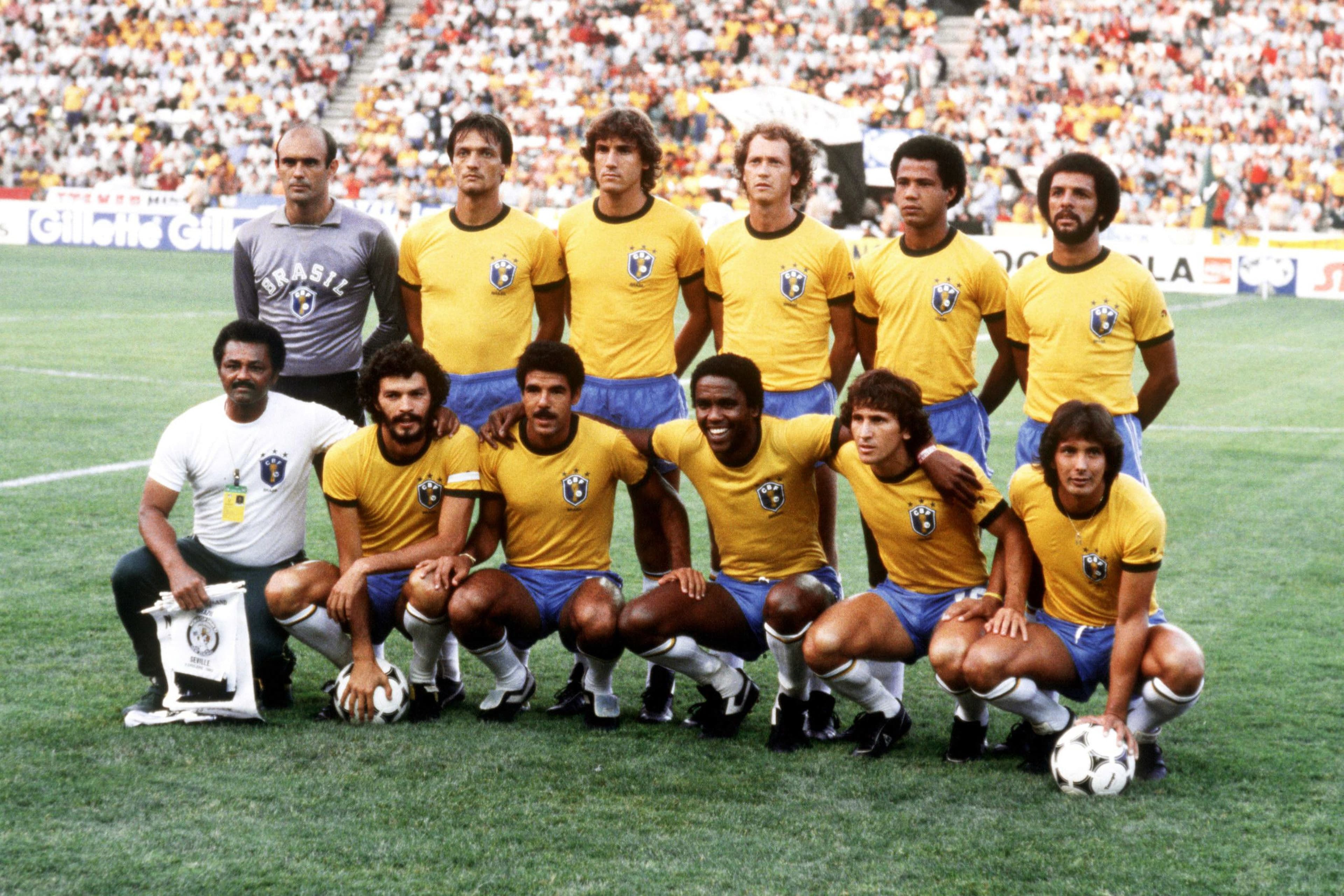
Series of Articles 3 of 3 – Brazil 1982
Brazil travelled to Spain with a midfield of rare intelligence, a captain who looked like a philosopher and a belief that football should offer beauty as well as victory. They did not win the World Cup, but more than four decades later, their football remains loved in a way many champions can only envy.
There are football teams remembered because they won. Their victories are preserved in record books, their captains are photographed holding trophies and their names become part of the official history of the game.
Brazil’s team of 1982 is remembered for something more complicated.
They did not reach the semi-finals of the World Cup. They did not play in the final, and they returned home without the trophy that many expected them to win. Yet supporters who watched them in Spain still speak about that side with unusual affection, while generations born after the tournament continue to discover the old footage and wonder how a team containing so much talent failed to become world champions.
The answer is partly football and partly philosophy.
Brazil in 1982 represented an idea of how the game ought to be played. They attacked with imagination, trusted technically gifted players and appeared to regard caution as something close to a betrayal of their footballing identity. Their manager, Telê Santana, believed that victory mattered, but he also believed the manner of victory mattered.
For many supporters, especially those old enough to remember the tournament unfolding on television, Brazil seemed to bring colour to the Spanish summer. Their yellow shirts were familiar, but the personalities inside them felt distinctive. Sócrates, Zico, Falcão, Toninho Cerezo, Júnior and Éder formed the creative heart of a team that played with intelligence, rhythm and an unmistakable sense of enjoyment.
The captain, Sócrates, looked unlike almost any elite footballer before or since. Tall, bearded and unusually thoughtful, he was a qualified doctor who later became closely associated with the Corinthians Democracy movement at club level. On the pitch, he played with an elegance that sometimes made difficult actions appear casual. His backheels became famous, but they were not tricks performed merely for effect. They were part of his way of seeing the game.
Alongside him stood Zico, the brilliant Flamengo playmaker often described as the White Pelé. Zico combined close control and passing vision with an exceptional ability to score. Falcão, then playing his club football in Italy with Roma, brought balance and sophistication to midfield, while Cerezo carried the ball forward and linked the different parts of the team.
Júnior attacked from left-back with the instincts of a midfielder. On the opposite flank, Leandro offered similar adventure. Éder provided power and invention from the left, including a left foot capable of producing spectacular goals.
It was an extraordinary collection of footballers.
The weakness, at least in the eyes of later critics, was that Brazil possessed so many creators and so few natural protectors. The midfield could dominate the ball and overwhelm opponents, but it did not always protect the defence in the manner expected of modern teams. Brazil’s football relied upon possession, movement and the belief that their technical superiority would eventually decide matches.
There was also an important absence before the tournament began. Careca, the gifted young centre-forward who would later become one of Brazil’s leading players, suffered an injury shortly before the World Cup and missed the competition. His place was taken by Serginho Chulapa, a more physical striker whose qualities were different from those of the creative players around him.
Even so, expectations remained enormous.
Santana had built a team that entered the World Cup unbeaten in 19 matches. During the previous year, Brazil had defeated England at Wembley, France in Paris and West Germany in Stuttgart within the space of a week. Their final warm-up before travelling to Spain brought a 7–0 victory over the Republic of Ireland.
This was not simply a side admired for attractive football. It was a team arriving with results, confidence and the expectation of becoming champions.
Their opening match against the Soviet Union provided an early warning that the tournament would not be effortless. Brazil fell behind and had to recover against a disciplined opponent. Sócrates equalised with a powerful strike before Éder scored a memorable late winner, controlling the ball before sending a fierce shot into the net.
The result was 2–1, but the manner of the recovery strengthened the growing sense that Brazil possessed something special.
Scotland were next.
The Scots took the lead through David Narey, but Brazil responded with four goals. Zico scored from a free kick, Oscar headed another, Éder produced a delicate finish and Falcão completed a 4–1 victory. The performance displayed the range of the team’s attacking ability. They could pass through opponents, score from distance and create opportunities from almost any area of the pitch.
New Zealand were then beaten 4–0, with Zico scoring twice and Falcão and Serginho adding the others. Brazil completed the first group stage with three victories, ten goals and growing support from neutral viewers.
The tournament format in 1982 was different from the familiar knockout structure used today. The 24 teams began in six groups, after which the 12 qualifiers entered a second group phase consisting of four groups of three. Only the winner of each second-round group progressed to the semi-finals.
Brazil were placed alongside Argentina and Italy.
The first match, against the reigning world champions Argentina, appeared to confirm Brazil’s superiority. Zico opened the scoring, Serginho added a second and Júnior finished a flowing move for the third. Diego Maradona was sent off late in the game before Argentina scored a consolation goal, leaving Brazil with a convincing 3–1 victory.
Italy had already beaten Argentina 2–1, meaning the final group match between Brazil and Italy would determine which side advanced. Because of goal difference, Brazil required only a draw. Italy had to win.
The contrast between the teams seemed almost too perfect.
Brazil had arrived as favourites, celebrated for their attacking football and individual expression. Italy had struggled through the opening group phase with three draws against Poland, Peru and Cameroon. They had scored only two goals and progressed ahead of Cameroon on goals scored.
Italian striker Paolo Rossi had not scored during the first four matches of the tournament. He had only recently returned to football following a suspension connected to the Totonero betting scandal, although Rossi always maintained his innocence of match-fixing. Manager Enzo Bearzot continued to select him despite intense criticism from the Italian press.
On 5 July 1982, at Barcelona’s compact Sarrià Stadium, that faith changed the course of the World Cup.
Rossi scored after five minutes, heading Antonio Cabrini’s cross beyond Waldir Peres. Brazil responded quickly. Zico escaped the attention of Claudio Gentile and supplied Sócrates, whose shot beat Dino Zoff at the near post.
At 1–1, Brazil were going through.
Rossi struck again after 25 minutes, capitalising on a loose pass by Cerezo. Once more Brazil found themselves behind, and once more they attacked. The game opened into one of the most compelling contests in World Cup history, with Brazil seeking the equaliser they needed and Italy threatening whenever possession changed hands.
Falcão eventually made it 2–2 in the second half. He received the ball outside the penalty area, moved into space and drove a powerful shot beyond Zoff. His celebration, arms clenched and face filled with emotion, became one of the enduring images of that Brazilian side.
At that moment, Brazil were again heading for the semi-finals.
They did not retreat.
That decision has been discussed ever since.
With a draw sufficient, Brazil might have slowed the game, protected possession and taken fewer risks. Instead, they continued to play as they had throughout the tournament. Their instinct was to seek another goal rather than defend the result they already possessed.
It is tempting to describe that as innocence or arrogance. The truth is probably less dramatic. This was simply how Brazil played. Asking the team to abandon its identity during the most important match of the tournament may have been tactically sensible, but it would also have required them to become something they were not.
In the 74th minute, Rossi completed his hat-trick after a corner was not cleared. Italy led 3–2.
Brazil attacked desperately in the closing stages. Oscar appeared to have headed an equaliser, but the 40-year-old Zoff stopped the ball on or near the line and held it before the Brazilian players could force it over. Zoff later described it as perhaps the most important save of his career.
The final whistle ended Brazil’s World Cup.
Italy went on to defeat Poland in the semi-final and West Germany in the final, with Rossi finishing as the tournament’s leading scorer. The Italian victory was no accident. Bearzot had created a resilient and tactically intelligent team, and Rossi’s sudden return to form became one of the great stories in World Cup history.
Brazil’s defeat was therefore not a case of beauty being cheated by negativity. Italy attacked when opportunities appeared, defended with extraordinary concentration and won a magnificent match. Their performance deserves to be remembered on its own terms.
Nevertheless, the result had consequences beyond the tournament.
In Brazil, the defeat became a national disappointment and a subject of lasting debate. Some believed the team had been too open and too committed to attacking football. The lesson drawn by later Brazilian sides was that artistry alone could not be trusted to win major tournaments.
When Brazil eventually returned to the summit in 1994, they did so with a more balanced and pragmatic team. Romário and Bebeto supplied the attacking talent, but midfielders such as Dunga and Mauro Silva provided discipline and protection. The contrast with 1982 was difficult to miss.
Yet the team that failed continued to inspire more affection than many sides that succeeded.
Perhaps that is because Brazil 1982 belongs to the era when international football still arrived with a degree of mystery. Supporters did not watch every player each week. There were no endless online clips or tactical breakdowns available before the competition. A World Cup could introduce an entire generation of footballers to a global audience within a few summer weeks.
For British viewers, especially, there was something memorable about watching names such as Sócrates, Zico and Falcão emerge on television. The football felt foreign in the best sense: expressive, technically rich and played to a rhythm that was recognisably Brazilian.
The team also benefited from the way memory works. Defeat freezes a side at the height of its possibility. We never saw Brazil 1982 grow cautious under the weight of a trophy or become reduced to a list of results. They remain forever the team in yellow moving forward, exchanging passes and appearing to believe that another beautiful goal was always available.
Nostalgia should not prevent honest assessment. Brazil had flaws. Waldir Peres was not regarded as a goalkeeper of the same class as the team’s finest outfield players. The defence could be exposed, and the midfield lacked the specialist defensive presence that later became standard at the highest level.
Their football was not perfect.
That is part of what makes the story human.
They attempted something ambitious and came painfully close to making it work. They chose creativity over caution, trusted gifted footballers and refused to treat fear as the starting point for tactical planning.
The debate over the greatest side never to win the World Cup will always remain open. Hungary in 1954 dominated international football for years before losing the final. The Netherlands in 1974 changed ideas about space and movement before being defeated by West Germany.
Brazil in 1982 offers a different claim.
They did not reach the final, yet they became one of the tournament’s defining teams. They are remembered less for tactical revolution than for the pleasure they gave those who watched them. Their legacy lives in the belief that football should occasionally be judged not only by the trophy lifted at the end, but by the feelings created along the way.
That is not an argument against winning. Brazil travelled to Spain to become world champions, and their players would undoubtedly have exchanged admiration for the trophy.
It is instead an acknowledgement that sport leaves more than one kind of legacy.
Italy won the World Cup and deserved to do so. Paolo Rossi became a national hero, and the match at Sarrià became one of the greatest victories in Italian football history.
Brazil left with nothing tangible.
No trophy. No final. Not even a place in the last four.
What they carried home was a reputation that has survived for more than forty years.
Supporters still remember the names. They still replay the goals. They still discuss whether Santana should have been more cautious and whether Careca’s presence might have changed the outcome. Most importantly, they still smile when they watch that team play.
Champions are remembered with respect.
Brazil 1982 is remembered with love.
For some football teams, that may be the rarest legacy of all.
Related Articles The Greatest Team Never to Win the World Cup: Hungary 1954 The Greatest Team Never to Win the World Cup: Netherlands 1974 Pelé: The Man Who Made Football Global
Majid Lavji
Founder & Editor
Majid Lavji is the Founder and Editor of Sports Lounge. With more than 30 years of experience across sport, media and business, he is passionate about telling the stories behind the games we love. Through Sports Lounge, he aims to provide intelligent, engaging sports journalism that values insight, history and context as much as results and headlines.