Every World Cup produces heroes.
Some emerge unexpectedly, enjoy a brief moment in the spotlight and gradually fade into football history. Others leave a deeper mark, becoming permanently associated with the tournament itself.
When football supporters think of the World Cup, certain images immediately come to mind. Pelé carried aloft by teammates in Mexico. Bobby Moore lifting the Jules Rimet Trophy at Wembley. Lionel Messi finally holding the World Cup in Qatar.
And then there is Diego Maradona.
For many supporters, particularly those old enough to have witnessed his career unfold, Maradona remains the most compelling figure the World Cup has ever produced. Not necessarily the greatest player, although many would argue exactly that. Not the most decorated. Not the most successful.
Simply the most unforgettable.
His story contains everything that makes sport so captivating. Brilliance, controversy, triumph, failure, redemption and contradiction. Even now, decades after his greatest performances, football still struggles to produce another figure quite like him.
Born in Villa Fiorito, a poor neighbourhood on the outskirts of Buenos Aires, Maradona emerged from circumstances that would become central to his identity. He never forgot where he came from and, in many ways, much of Argentina never stopped seeing him as one of their own.
Football was his route out.
His talent became obvious almost immediately.
By the age of 16, he had already made his debut for Argentina. Supporters who watched him as a teenager often describe the same thing: a sense that they were witnessing something different. Not simply a gifted footballer, but a player capable of seeing possibilities others could not.
His first World Cup arrived in 1982 in Spain.
Argentina entered the tournament as defending champions, but the competition proved disappointing. Maradona showed flashes of brilliance but also frustration, eventually receiving a red card in a defeat against Brazil. It was a difficult introduction to football's biggest stage.
In hindsight, however, it was merely the beginning.
Four years later came Mexico 1986.
For many football supporters, it remains the defining World Cup of the modern era.
Maradona arrived in Mexico as one of the world's leading players. What followed elevated him into something larger. Across seven matches, he produced a sequence of performances that continue to shape discussions about football greatness nearly forty years later.
Argentina were not considered overwhelming favourites.
They possessed talented players, but few observers expected one individual to dominate a tournament so completely.
Yet that is precisely what happened.
Maradona scored five goals and created five more as Argentina marched towards the final. Statistics alone, however, fail to capture the extent of his influence. He appeared involved in everything. Every attack seemed to flow through him. Every opponent knew the danger he represented and still struggled to stop him.
The quarter-final against England remains one of the most discussed matches in football history.
The political backdrop added significance. Just four years earlier, Britain and Argentina had fought the Falklands War. Emotions remained raw on both sides.
What happened next ensured the match would never be forgotten.
Maradona's first goal became known as the "Hand of God". Rising alongside England goalkeeper Peter Shilton, he punched the ball into the net. The officials missed the offence and the goal stood.
The controversy was immediate.
Nearly four decades later, opinions remain divided.
Yet what happened four minutes later is perhaps even more extraordinary.
Collecting the ball inside his own half, Maradona embarked on a run that carried him past five England players before rounding Shilton and scoring. The goal has been replayed countless times and is frequently described as the greatest in World Cup history.
The contrast between the two goals somehow captured Maradona perfectly.
One controversial.
One magical.
One impossible to defend.
One impossible to explain.
Together they created football folklore.
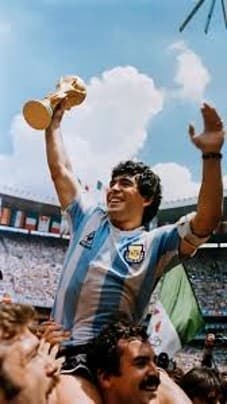
The tournament continued in similar fashion. Maradona inspired Argentina past Belgium in the semi-final before defeating West Germany in the final. When the trophy was lifted in Mexico City, there was little doubt who had been the tournament's defining figure.
World Cups are often won by great teams.
Argentina had won one largely because they possessed a great player.
For many supporters of a certain age, Mexico 1986 remains the benchmark against which individual World Cup performances are measured.
Maradona's story, however, was never straightforward.
The qualities that made him so captivating on the pitch often contributed to difficulties away from it. His career became increasingly complicated by personal struggles, controversies and battles with addiction. The football genius remained, but the burden of fame appeared to grow heavier.
Yet perhaps that complexity is part of the reason he continues to fascinate.
Modern sport often presents athletes as polished brands. Public relations teams manage every interview. Social media accounts are carefully curated. Personalities are refined into marketable products.
Maradona belonged to a different era.
He was flawed.
Unpredictable.
Occasionally self-destructive.
Yet undeniably authentic.
Supporters never felt they were watching a manufactured version of Diego Maradona. They were watching the real person, for better and for worse.
His final World Cup in the United States in 1994 reflected both his enduring brilliance and his personal struggles. A memorable goal against Greece briefly suggested another remarkable chapter might be unfolding. Instead, the tournament ended in controversy following a failed drugs test.
It was a sad conclusion to his World Cup career.
Yet even that could not diminish what had come before.
The years since have only strengthened his place in football history.
Younger supporters who never saw Maradona play often encounter him through highlights and documentaries. Older supporters remember something different. They remember the feeling. The anticipation whenever he received the ball. The sense that something extraordinary might happen at any moment.
That is difficult to measure.
Statistics can be compared.
Trophies can be counted.
The emotional impact of a player is harder to quantify.
Maradona possessed that rare ability to make football feel unpredictable.
Supporters watched because they genuinely did not know what might happen next.
Perhaps that is why discussions about football's greatest players inevitably include his name. The debate itself is almost secondary. What matters is that his influence remains impossible to ignore.
As the World Cup prepares for another chapter in 2026, new stars will emerge and fresh memories will be created. Young supporters will discover players who define their own generation.
That is the beauty of football.
Every era produces new heroes.
Yet some figures remain timeless.
Diego Maradona belongs firmly in that category.
A player capable of infuriating, inspiring and astonishing in equal measure.
A footballer whose story was never simple.
And a World Cup legend whose shadow still stretches across the tournament he helped define.
Majid Lavji
Founder & Editor
Majid Lavji is the Founder and Editor of Sports Lounge. With more than 30 years of experience across sport, media and business, he is passionate about telling the stories behind the games we love. Through Sports Lounge, he aims to provide intelligent, engaging sports journalism that values insight, history and context as much as results and headlines.